
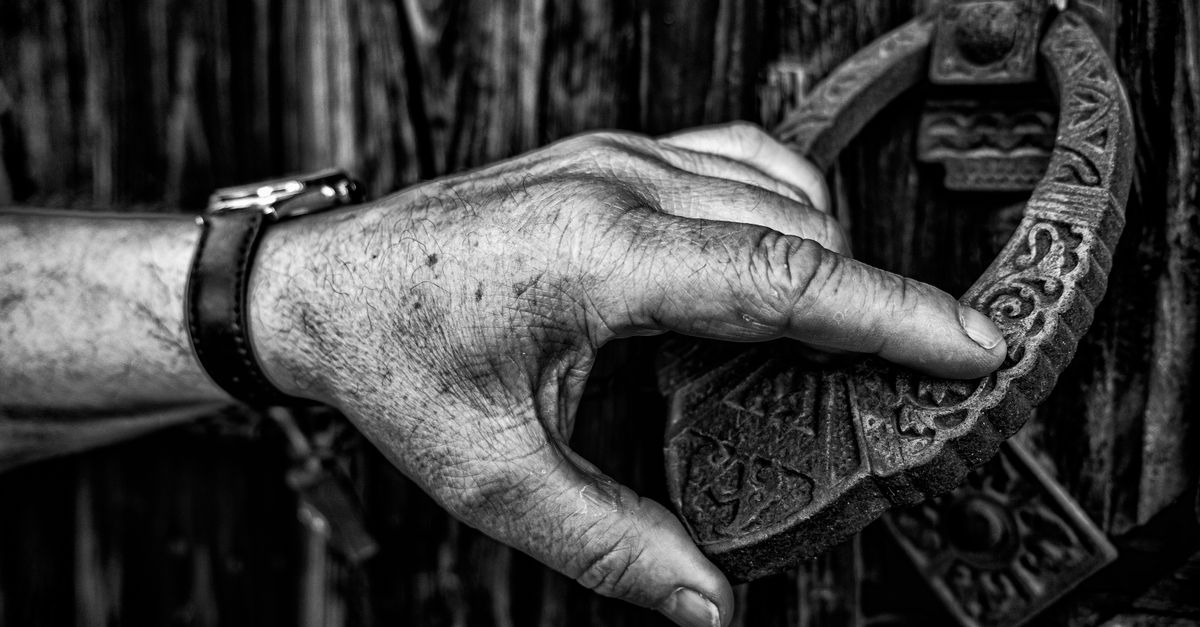
You’re describing your healthy year, your clean driving record, your kid’s good grades. Then you pause mid-sentence, reach over, and rap your knuckles twice on the nearest table. You might not believe a wooden desk has magical properties. You probably don’t. But you knocked anyway.
The short answer
We don’t know exactly where knocking on wood came from, but the best theories trace it to ancient beliefs about wood as a sacred material—either because spirits lived in trees, or because wood connected to the Christian cross. The phrase “knock on wood” itself is surprisingly modern, first documented in the early 1900s in both America and Britain. We still do it because the ritual offers a measurable psychological buffer against anxiety, and research shows superstitious gestures can actually improve performance under pressure, even when we don’t literally believe they work.
The phrase is newer than you think
Here’s the first surprise: the English phrase “knock on wood” doesn’t appear in print until the early twentieth century. The Oxford English Dictionary traces the earliest clear written example to around 1905. That’s recent. Shakespeare never knocked on wood. Neither did Ben Franklin.
The American variant “knock on wood” and the British “touch wood” emerged around the same time on both sides of the Atlantic, which suggests something interesting about how the superstition spread. Immigration records and newspaper archives from the late 1800s show massive movement of people between Britain, Ireland, and America. The phrase likely traveled in working-class speech—the kind that doesn’t show up in formal writing until it’s already common. By 1905, when it first appeared in print, people were already using it casually enough that writers didn’t bother explaining it.
This timing problem matters. Most of the origin stories people tell—pagan tree spirits, medieval monks—are much older than the documented phrase. That doesn’t make them wrong, but it does mean we’re working backward from a modern habit to guess at ancient roots. The gap between “ancient practice” and “twentieth-century documentation” is where most of the guesswork lives.
The tree spirit theory
The most popular explanation goes like this: ancient pagan cultures across Europe believed spirits lived inside trees. When you said something boastful or tempting to fate, you knocked on a tree to wake the protective spirit, or to ask for its blessing, or to thank it for good fortune already received.
This theory fits what we know about pre-Christian European religions and their reverence for sacred groves. Trees were seen as conduits between earth and sky. Oak, ash, and hawthorn had particular power. Knocking on wood would have been a way to anchor yourself to that natural, protective force.
The problem is that we have almost no direct evidence linking ancient tree-knocking to the modern superstition. The connection is plausible—wood symbolism is old and widespread—but it’s educated guesswork. Folklorists at the Library of Congress point out that many “ancient pagan” origin stories for modern customs were invented or embellished by nineteenth-century Romantics who wanted a mystical past to match their nostalgia.
The Christian reinterpretation

Another theory routes the practice through Christianity. Wood, in this version, represents the wooden cross on which Jesus was crucified. Touching wood was a way to invoke the protection of the cross, especially when you’d said something prideful and needed divine mercy.
Some versions of this story include medieval pilgrims touching wooden relics—pieces of the “true cross” kept in churches—as they prayed. Over time, the gesture generalized to any wood.
This explanation has the advantage of connecting wood symbolism to a specific religious object with documented significance. It also parallels other Christian protective gestures: crossing yourself, kissing a rosary, touching a Bible. The timing still doesn’t quite work—medieval Christians touched holy wood, but did they specifically knock on ordinary tables to avert bad luck after a boast? We don’t have that documented.
Why wood, specifically?
Whether the roots are pagan or Christian, both theories assume wood has symbolic power. That part we can confirm. Across cultures, wood occupies a strange middle status: it was alive, now it’s not, but it still feels warm and organic in a way stone and metal don’t. It burns, it rots, it holds the memory of the tree.
In many traditions, wood is a threshold material. Coffins are wood. Doors are wood. Wands and staffs and ships—anything that mediates between one state and another. If you believe knocking on wood works, you’re implicitly treating the material as a kind of membrane between the lucky present and the unlucky future you’re trying to avoid. You’re asking the wood to hold the line.
How the superstition varies around the world

Here’s what makes the superstition interesting: similar practices show up in cultures with no direct contact, but the details shift in revealing ways.
In Turkey, people say tahtaya vur (“knock on wood”) and typically knock three times, not two. The phrase is paired with invoking God’s protection—it’s not just the wood doing the work. In parts of the Middle East, you knock and then add mashallah (“God has willed it”), which reframes the gesture as religious rather than magical.
In Italy and parts of Southern Europe, people touch iron instead of wood—tocca ferro—after a risky statement. Same impulse, different material. The switch suggests the core superstition isn’t about wood’s sacred properties but about the act of grounding yourself to something solid and real.
In Jewish tradition, some people say keinehora (a Yiddish phrase meaning “no evil eye”) while knocking, which explicitly names the threat the ritual is meant to ward off. In parts of India and Pakistan, the gesture exists but without a standard phrase—you just knock, and everyone knows why.
What’s striking is that the number of knocks, the accompanying words, and even the material all vary, but the underlying structure stays the same: you said something tempting to fate, you perform a small physical gesture, you move on. The ritual is flexible enough to fit into Christian, Muslim, Jewish, and secular contexts without losing its function.
The psychology of why it works
The real question isn’t where knocking on wood came from. It’s why people who don’t believe in magic still do it.
The answer is that the ritual works—not by changing external reality, but by giving you something to do with the uncomfortable feeling that follows a boast. Research documented by Psychology Today shows that superstitious behaviors can reduce anxiety and improve performance under pressure, especially in competitive or high-stakes situations. Athletes who perform pre-game rituals report feeling more in control, even when they know intellectually the ritual has no causal power. The gesture doesn’t need to work objectively; it just needs to feel like you did something, rather than nothing.
Psychologists call these “compensatory behaviors.” You’ve just said something that feels like tempting fate. You don’t actually think fate is listening, but your brain has registered a small spike of social or existential risk. Knocking on wood completes the moment. It’s a reset button. Studies on performance under uncertainty show that even non-believers who engage in superstitious gestures experience measurable reductions in stress markers and improvements in focus. The ritual creates a sense of control in an uncontrollable situation, and that psychological shift is real, even if the magic isn’t.
When the superstition crossed the Atlantic
The timing and geography of “knock on wood” suggest it became standardized during a specific window of mass migration. Between 1880 and 1920, millions of people moved from Britain and Ireland to the United States, bringing regional folk sayings with them. The phrase likely existed in scattered oral form before 1905 but gained its modern shape as immigrants from different regions blended their versions into a common idiom.
Historical records from the Smithsonian on American folklore show that many “American” superstitions from this era are actually hybrid forms—Irish, English, Scottish, and German traditions merging in cities and factory towns. “Knock on wood” fits that pattern. The British “touch wood” and American “knock on wood” aren’t one copying the other; they’re parallel developments from a shared root that standardized just as mass print media and cross-Atlantic communication exploded. By the time the phrase appeared in newspapers and novels, it was already everywhere.
Why it stuck
Most superstitions fade. We don’t avoid stepping on cracks anymore, not seriously. We don’t fear breaking mirrors the way Victorians did. But knocking on wood has survived because it asks almost nothing of you. No special tools, no specific wood, no belief system required. You don’t have to cross yourself or burn sage or throw salt. You just knock.
It’s the lowest-commitment superstition available, which makes it the easiest to pass on. A parent knocks, a kid asks why, the parent shrugs and says “just in case,” and the habit replicates. No catechism required.
Next time you knock, notice what you’re feeling. It’s probably not belief in tree spirits. It’s the tiny relief of a completed gesture—a way to close the loop on a moment of vulnerability. According to research on behavioral psychology and ritual, that relief is measurable. The ritual works because you do it, not because the wood is magic. Which is its own kind of interesting.