

A jellyfish sleeps eleven hours a day. It has no brain. No central nervous system. Just a loose network of nerves and a body plan older than trees. Yet in 2021, researchers confirmed what seemed impossible: jellyfish enter a sleep-like state where they’re less responsive, move slower, and need recovery time if you keep them awake. Sleep, it turns out, existed before brains did.
That realization changes the question. Sleep isn’t a feature brains invented to dream or consolidate memories. It’s something deeper, maybe cellular. Current research suggests sleep clears metabolic waste—toxic proteins like beta-amyloid and tau—from tissue through a flush-and-drain system that only works during rest. If that’s true, sleep isn’t behavioral strategy. It’s molecular housekeeping. Every cell that burns energy creates garbage. Sleep is when you take it out.
Which reframes everything we’re about to see. When animals sleep in ways that look broken or bizarre compared to our own eight-hour nights, they’re not failing at rest. They’re showing us the trade-off: this particular way of resting is worth the risk. Sleep costs you vigilance. It leaves you vulnerable. Every species that still does it has run the math and decided the metabolic debt is worse than the danger.
Here’s what that calculation looks like across the animal kingdom.
1. Jellyfish: Sleep Before Brains
The upside-down jellyfish (Cassiopea) pulses gently in shallow water, its bell contracting about once per second during the day. At night, that pulse slows. The jellyfish becomes less responsive to food stimuli. If you keep it awake—by pulsing water at it all night—it’s sluggish the next day, like it needs to catch up.
The study that confirmed it used the same criteria scientists use for mammals: reduced responsiveness, a specific resting posture, and a rebound effect after deprivation. Jellyfish meet all three. The implications stretch backward through evolutionary time. Sleep isn’t something vertebrate brains invented. It predates complex nervous systems entirely. The fact that a creature with no brain still pays the cost of sleep—still becomes vulnerable, still needs recovery—suggests the benefit operates at a level more fundamental than thought or memory. Waste clearance. Cellular repair. Metabolic reset. Things that matter whether you have a cortex or not.
2. Dolphins and Whales: The One-Hemisphere Solution
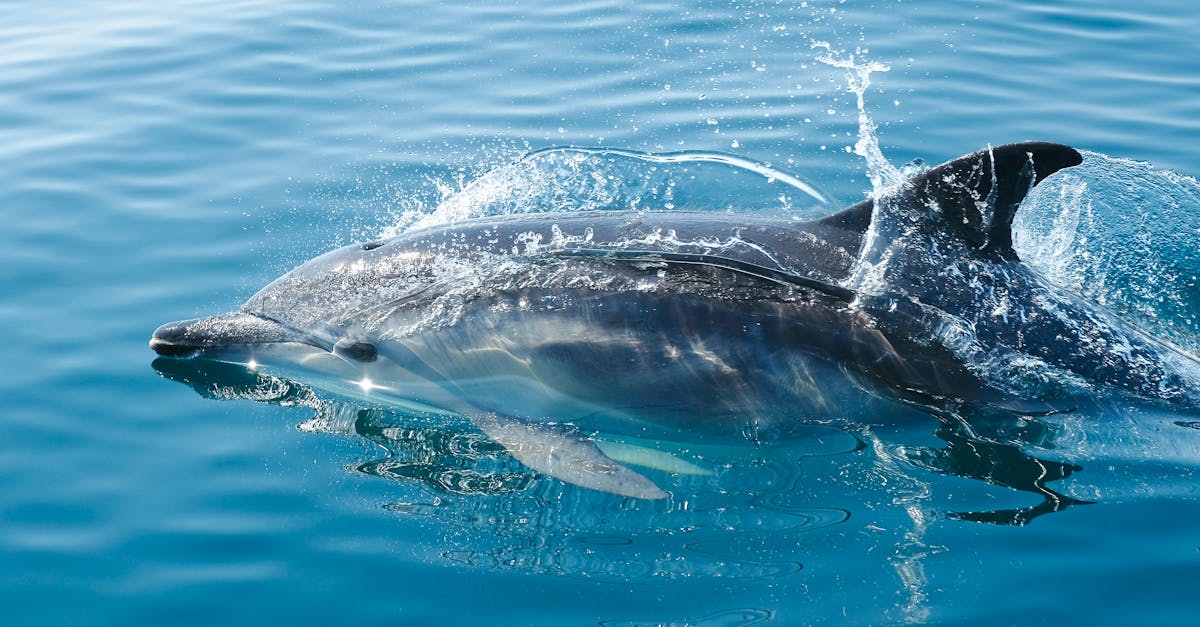
Dolphins can’t afford to fall fully asleep. They’re voluntary breathers—if they go unconscious, they drown. The solution evolution found is called unihemispheric slow-wave sleep: one half of the brain sleeps while the other stays awake and keeps the dolphin surfacing for air.
Research on bottlenose dolphins shows they can maintain this state for hours, alternating which hemisphere rests. One eye stays open (the one connected to the awake hemisphere), watching for predators or obstacles. It’s not a compromise. It’s a fully functional sleep mode for an animal whose habitat makes bilateral sleep impossible. Whales, seals, and some migratory birds use the same trick. The unihemispheric pattern may actually be older than the “both sides at once” sleep most mammals do.
3. Giraffes: The Prey Animal’s Fragmented Night
A giraffe sleeps about twenty minutes per day. Not in one block—in fragments. Five minutes here, three minutes there, spread across roughly twenty short naps. During those twenty minutes, the giraffe gets maybe thirty seconds of REM sleep total. Thirty seconds of dreams in an entire day.
This is what being prey looks like. Giraffes are massive, but they’re not fast from a standstill, and lying down makes them even more vulnerable. The sleep pattern reflects that calculation. They doze standing up most of the time, using the same joint-locking trick horses use. Only rarely do they fold those long legs beneath them for deep sleep, and when they do, it’s brief.
Here’s what makes this pattern sustainable: it’s not broken sleep. It’s polyphasic sleep—rest distributed across multiple short windows rather than one long block. Humans can do this too. Sailors on watch, new parents, shift workers—all demonstrate that monophasic eight-hour sleep is partly cultural, partly industrial-revolution scheduling, not a hardwired requirement. The giraffe isn’t failing to sleep properly. It’s operating at one end of a spectrum that runs from consolidated rest (lions, humans in stable environments) to radically fragmented rest (giraffes, horses, prey in open terrain). Position on that spectrum tracks directly to predation risk.
The stakes are real. Sleep-deprived mammals show cognitive collapse, immune failure, and—in extreme cases—fatal outcomes. Rats deprived of all sleep die within weeks. The giraffe’s twenty-minute budget isn’t luxury. It’s the minimum viable dose to clear waste, stabilize memory, and keep the organism functional. Any less and the system fails. Any more and the giraffe doesn’t survive long enough to reproduce.
4. Horses: The Stay Apparatus and the Standing Nap
Horses sleep about three hours a day, in short naps lasting a handful of minutes each. Most of those happen standing up. They can do this because of something called the stay apparatus—a system of tendons and ligaments that locks their leg joints in place. The horse isn’t consciously holding itself up. Its skeleton is doing the work.
But here’s the catch: horses can only get light, non-REM sleep while standing. For REM sleep—the kind where muscles go slack and the brain consolidates memory—they have to lie down. They do this in brief bursts, usually when they feel safe. A horse that never lies down is a horse that’s chronically stressed, running up a metabolic debt that eventually shows in health and behavior.
Like the giraffe, the horse demonstrates polyphasic sleep as a functional strategy, not a defect. The standing nap is a vigilance tool. The lying-down REM burst is the cellular maintenance window. Together they form a complete sleep architecture calibrated to survival pressure.
5. Predators Sleep Long and Deep
A lion sleeps sixteen to twenty hours a day. Not in fragments. Not standing up. Long, deep, bilateral sleep. Why? Because it can. Predators at the top of the food chain don’t face the same vulnerability cost that prey animals do. A lion has few natural threats. It’s metabolically expensive to be a lion—hunting burns enormous energy—so the rest of the day is spent conserving it.
The study that mapped sleep duration to ecology found a clean pattern: predators sleep longer than prey, and prey that live in the open sleep less than prey that can hide. Sleep duration isn’t random. It’s survival strategy made visible. The lion’s sixteen-hour rest day and the giraffe’s twenty-minute fragments are opposite ends of the same evolutionary logic. Both are optimal. Both work. The difference is risk.
6. Birds: One Eye Open, One Hemisphere Resting

Many bird species—particularly those that perch in the open—sleep with one eye open and one brain hemisphere awake. Ducks do this. So do parrots and some migratory species. The setup is identical to dolphins: unihemispheric slow-wave sleep, with the eye opposite the resting hemisphere closed.
Research on avian sleep shows that birds can adjust how deeply each hemisphere sleeps depending on where they’re positioned in a flock. Birds on the edge of the group keep one hemisphere more alert; birds in the center sleep more symmetrically. It’s a sliding scale, not a binary switch. The brain doesn’t just rest—it rations rest according to threat. Some migratory birds can even sleep while flying, alternating hemispheres to stay aloft during multi-day ocean crossings.
7. Platypuses: The REM Anomaly
Platypuses sleep about eight hours a day, which sounds normal until you measure their REM sleep. They get almost none—less than 0.1% of total sleep time, compared to 20% or more in most mammals. Platypuses are monotremes, egg-laying mammals whose lineage split off before marsupials and placentals evolved. Somewhere in that evolutionary distance, they either lost REM sleep or never fully developed it.
We don’t know why. One hypothesis suggests that REM sleep’s role in memory consolidation may matter less for animals that rely heavily on instinct rather than learned behavior. Another possibility is that monotreme brains consolidate memory through a mechanism we haven’t identified yet. Either way, the platypus is a reminder that even among mammals, sleep architecture isn’t universal. The functions we assume REM performs—memory, emotional regulation, synaptic pruning—may happen through different neural mechanisms in different lineages.
8. Bullfrogs: The Paradox Species
Bullfrogs (Rana catesbeiana) may not sleep at all. Despite extensive observation, they show no clear REM or NREM sleep stages in their brains. They respond to stimuli just as quickly at night as during the day. They don’t show sleep rebound after deprivation. If sleep is universal, bullfrogs are the exception we can’t explain yet—or the species teaching us we’ve been measuring sleep wrong the entire time. It’s possible they rest through a mechanism we don’t recognize, one that doesn’t match the mammalian or avian sleep templates we use to define rest.
What This Tells Us
Sleep looks weird when you measure it against your own. A giraffe’s twenty-minute day seems broken. A dolphin’s half-awake brain seems like torture. But these aren’t failures. They’re adaptations as precise as echolocation or camouflage—just harder to see because they happen in rest rather than action.
The broader insight: sleep is plastic. It bends to fit the constraints of habitat, predation, breathing, migration, and metabolic load. The fact that it bends but never breaks—that even jellyfish pay the cost—suggests the underlying need is non-negotiable. Somewhere at the cellular level, rest isn’t optional. How you get it, how long it lasts, whether you do it with one hemisphere or two—those are negotiable. But the metabolic reset itself? That’s the price of being alive.
Human sleep may be more flexible than we assume. The eight-hour consolidated block is a modern invention, shaped by artificial light and industrial schedules. Polyphasic sleep isn’t a giraffe’s burden—it’s an option our own biology supports when circumstances demand it. What looks strange in animals is often just a visible version of something we do, or could do, under pressure.
The animal that sleeps strangely is the animal that survived.
Frequently Asked Questions
Do all animals need sleep?
Almost certainly. If an animal has a metabolism and a nervous system, it sleeps—even if we haven’t figured out how to measure it yet. The jellyfish discovery shows that sleep is older than brains. Bullfrogs remain the main exception we can’t explain.
Why do some animals sleep with one eye open?
It’s called unihemispheric sleep. One brain hemisphere rests while the other stays alert. It lets aquatic mammals breathe, lets prey animals watch for threats, and lets migrating birds sleep mid-flight. It’s not a compromise—it’s a fully functional adaptation.
How do whales and dolphins sleep underwater?
Through unihemispheric sleep. One brain hemisphere sleeps, the other stays awake to control surfacing and breathing. They alternate which side rests. A dolphin never fully loses consciousness the way you do.
Is fragmented sleep unhealthy?
Not if you’re adapted for it. Giraffes and horses thrive on polyphasic sleep because their biology supports it and their environment demands it. Humans can shift to polyphasic patterns under pressure, but chronic fragmentation without adaptation leads to metabolic and cognitive costs. Context matters.