
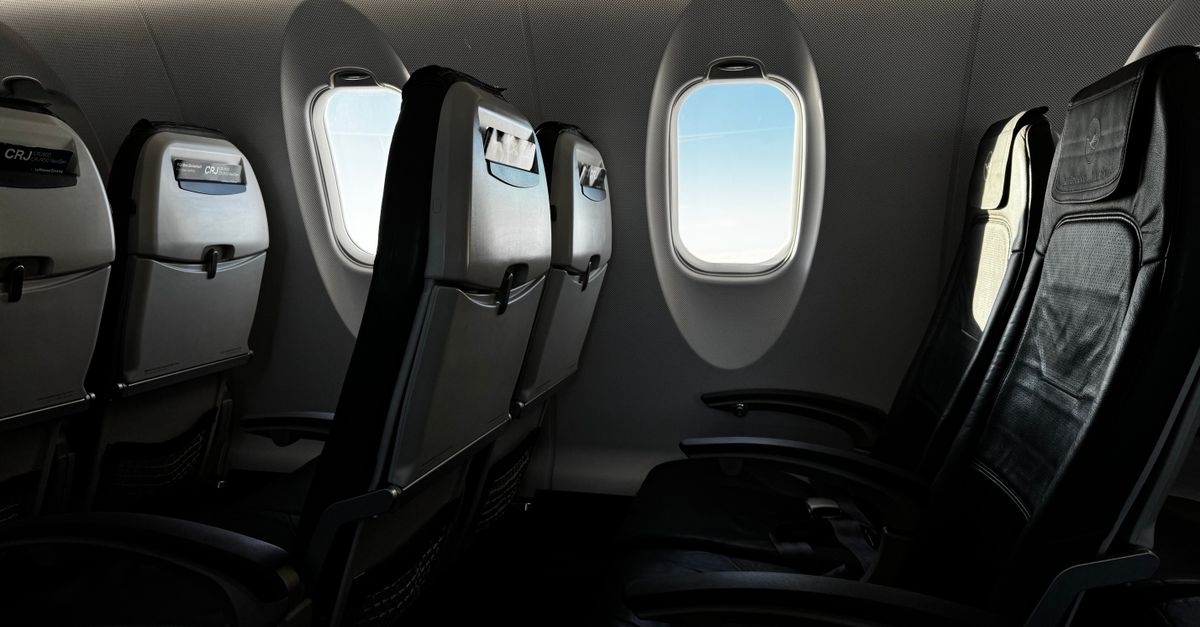
You’re buckled in, the engines spool up, and the cabin goes dark. Not completely dark—more like dim enough to notice, dim enough to wonder if something’s wrong. It happens on every flight, usually without announcement, and if you’ve ever asked yourself why the airline safety rituals include this specific one, you’re not alone.
The short answer
Planes dim the cabin lights during takeoff and landing so your eyes pre-adjust to darkness. If the aircraft has to evacuate at night or in low visibility, you’ll be able to see emergency lighting and exits immediately instead of spending the first 20 to 30 seconds stumbling through near-total darkness. Those seconds matter in a 90-second evacuation window.
Your eyes need a head start
Human eyes are slow to adapt to darkness. In total darkness, your pupils take 20 to 30 minutes to fully dilate and reach what vision scientists call scotopic vision—the night-adjusted state where you can actually see. In a dimmed cabin, though, your eyes adapt in one to two seconds. They’re already primed.
This isn’t abstract. The FAA requires all commercial aircraft to demonstrate full evacuation of passengers and crew in 90 seconds or less, with half the exits blocked. The certification tests are brutal: actual people, actual aircraft, actual stopwatch. And those tests revealed something important—lighting conditions significantly affected how fast people could navigate exits.
The dimming standard is precise. Federal regulations specify that emergency lighting must provide at least 0.05 foot-candles of illumination measured at floor level along the emergency exit path—a level low enough to preserve dark adaptation while keeping the aisle visible. That threshold isn’t arbitrary. It’s the tested minimum where eyes stay adjusted to darkness without forcing passengers to navigate in the blind.
The crash that proved it

The cabin lights takeoff reason isn’t hypothetical. It came from real accidents—specifically, a 1989 crash investigation that changed how airlines think about evacuation lighting.
British Midland Flight 92 crashed near Kegworth, UK, after an engine failure. The UK Air Accidents Investigation Branch documented the evacuation in detail: passengers who evacuated into daylight on one side of the aircraft cleared exits measurably faster than those evacuating into darkness on the opposite side, where disorientation and poor visibility created bottlenecks. Investigators noted that passengers exposed to sudden darkness after bright cabin lighting took longer to locate exits, slowing the entire evacuation flow during the critical first minute.
That data made its way into aviation safety protocols worldwide. The FAA formalized dimming requirements, and equivalent rules appeared in European and international standards. The specific cause wasn’t just “darkness is bad.” It was “sudden darkness after bright cabin lighting is disorienting enough to slow evacuations dangerously.”
It’s also a signal

Here’s the part most explainers miss: dimming the cabin lights isn’t just a physical safety measure. It’s a procedural checkpoint.
When the lights dim, the flight crew knows the aircraft has entered a critical phase. Passengers may not consciously register it, but the dimming itself conditions alertness. You notice the change. Your brain notes the transition. It’s a subtle alert that says: this is not cruising altitude, this is a moment where things could go wrong.
That’s the thing about airline safety rituals—they feel invisible or theatrical until you see the accident data. Dimming lights, crosschecking doors, sterile cockpit rules during critical phases. Individually, they’re mundane. Together, they’re a system built from specific disasters.
When it happens (and why night landings matter more)
Lights dim during takeoff, landing, and sometimes during cruise when flying through darkness. The most critical scenario isn’t actually takeoff—it’s night landing.
Most takeoffs happen in daylight. Night landings, especially in bad weather or at unfamiliar airports, are when an emergency evacuation in darkness is most likely. If the aircraft skids off a runway into mud or grass at 11 p.m., the cabin is already dim, your eyes are already adjusted, and you can see the emergency lighting strips along the aisle immediately.
The procedure applies to both takeoff and landing because critical phases get treated identically, but the real-world scenario regulators were solving for was the night arrival.
FAQ
Is this just an FAA rule, or do all airlines do it?
It’s a global standard. The FAA requires it for U.S. carriers, but EASA and ICAO have equivalent requirements. If you’re flying internationally, the same dimming procedure applies.
Can you ask the flight attendant to turn the lights back up?
Not during critical phases. The request would be denied—it’s a non-negotiable safety procedure tied to specific moments in the flight. Once the aircraft reaches cruising altitude, cabin lighting goes back to normal.
Does this actually speed up evacuations, or is it just precautionary?
It makes a measurable difference. Research from accident investigations shows that passengers whose eyes are already adjusted to darkness can navigate to exits faster than those suddenly plunged from a brightly lit cabin into total darkness. In a 90-second evacuation window, that difference matters.
You probably won’t ever need to evacuate an aircraft in darkness. But the dimming procedure exists because people have needed it, and the difference in evacuation speed has been documented in crash investigations. Next time the cabin goes dim, you’ll know: your eyes are being quietly prepared for an emergency you’ll almost certainly never face. That’s good design.