

Here’s the thing about searing meat in a cast-iron pan: cooks were doing it for four hundred years before anyone knew why it actually worked. They just knew browned things tasted better and looked impressive. The science—the Maillard reaction, the chemical cascade that creates those flavors—wasn’t identified until 1912 by a French chemist named Louis-Camille Maillard. We were practicing the technique long before we understood it.
That gap between doing and knowing shows up everywhere in culinary history. Most of the cooking techniques we now teach as fundamentals didn’t start as mastery or refinement. They started as survival. Smoking meat, fermenting vegetables, braising tough cuts—people invented these methods because they didn’t have refrigerators, couldn’t afford tender cuts, or needed food to last through winter. We kept doing them after the problems were solved, and eventually figured out why they tasted so good. That’s the real story.
1. Searing and Browning: The Myth That Worked Anyway
Medieval cooks seared meat because it looked good and made things taste better. They also believed—incorrectly—that searing “sealed in juices.” It doesn’t. When Cook’s Illustrated tested this in controlled experiments, they found the opposite: seared meat actually loses more moisture than unseared meat. The surface browning doesn’t create a seal. It creates an opening for water to escape.
So why do we still sear? Because the flavor gains outweigh the moisture loss by a mile.
The Maillard reaction—the actual process responsible for browning—creates over 1,000 distinct flavor compounds when amino acids and reducing sugars react at temperatures above 300°F. That’s hundreds of new tastes and aromas that didn’t exist before you applied heat. The complexity is staggering. A piece of boiled chicken has maybe a dozen flavor compounds. A seared one has a thousand.
Harold McGee’s On Food and Cooking traces this timeline in detail: centuries of empirical practice followed by a sudden explanation in 1912. People were doing it right for the wrong reasons. They thought they were trapping moisture. They were actually building flavor architecture, one browned crust at a time.
2. Smoking: Geography as Destiny
Smoking meat wasn’t about flavor. Not at first. It was about making it through winter.
In Northern Europe and Scandinavia before the 1800s, salt was expensive and scarce. Smoking fish and meat over low fires was the affordable preservation method. You smoked because refrigeration didn’t exist and you couldn’t afford to let protein rot. The technique became dominant in regions where wood was plentiful and salt was not—a pure economics decision.
The same problem produced radically different solutions elsewhere. In coastal Southeast Asia, fish sauce fermentation replaced smoking: abundant fish, hot humid climate, and access to sea salt made liquid preservation more practical than smoke. In the American South, hickory and oak defined the smoking tradition because those were the trees that grew there. In Iceland, it was birch and sheep dung—not because anyone preferred it, but because timber was scarce and fuel was precious.
Once refrigeration arrived in the 1920s, smoking persisted. Not out of necessity, but because people liked the taste. The technique outlived its original purpose by a century. We’re now building backyard smokers and debating wood types in climate-controlled suburbs. That’s either deeply human or faintly absurd.
3. Fermentation: The Chemistry of Controlled Rot
Fermentation is one of the oldest cooking techniques we have. Food historian Sandor Katz documents evidence of fermented foods in Mesopotamia around 6000 BCE, with the oldest known recipe—Sumerian, dated to 1800 BCE—being for beer.
The reason was straightforward: fermented food didn’t spoil. Cabbage became sauerkraut, milk became yogurt, grapes became wine. You fermented because it was that or throw it out. The tangy, complex flavors we now prize were side effects, not goals.
But the side effects were worth understanding. When lactobacillus bacteria ferment vegetables—sauerkraut, kimchi, pickles—they break down proteins and release free glutamate, the compound responsible for umami. That savory depth isn’t an accident. It’s biochemistry. The longer the fermentation, the more glutamate accumulates, which is why aged kimchi tastes richer than fresh cabbage ever could.
Japan solved the same problem differently. Instead of lactobacillus, koji mold (Aspergillus oryzae) became the umami engine. Koji fermentation produces not just glutamate but also nucleotides like inosinate, which amplify savory flavor exponentially when combined. That’s the backbone of miso, soy sauce, and sake—three staples born from the same mold culture, applied to different ingredients.
Both traditions—European lactobacillus fermentation and Japanese koji fermentation—emerged independently to solve the same problem: preserve food, make it last. The fact that they also made food taste profoundly better is why we’re still doing it in an era of refrigeration and global supply chains. Once consumers learned the science, they learned to seek umami-creating microbes intentionally. That’s how a survival technique became a $15-jar wellness trend.

4. High-Heat Cooking: When Fuel Scarcity Shaped Technique
The wok didn’t become the dominant cooking vessel in China because it was trendy. It became dominant because fuel was expensive and cooking needed to be fast.
Traditional Chinese kitchens used charcoal or wood, both scarce and costly in densely populated regions. The wok’s shape—wide, thin, conductive—maximizes heat transfer and allows food to cook in minutes at very high temperatures. You’re not braising for hours. You’re stir-frying for three minutes, using a fraction of the fuel. The technique is an adaptation to resource scarcity, not a culinary preference.
The same logic explains the tandoor oven in South Asia. Clay construction retains heat efficiently, and the vertical design allows multiple flatbreads to cook simultaneously on the oven walls while meat roasts in the center. One fire, maximum output. These weren’t invented because they produced the best flavor—though they do—they were invented because they worked within the constraints of available materials and fuel costs.
Technique follows resources. Geography is destiny. The methods we now celebrate as cultural heritage started as economic necessity.
5. Braising: Making Do with Tough Cuts
Braising exists because poor people needed to eat.
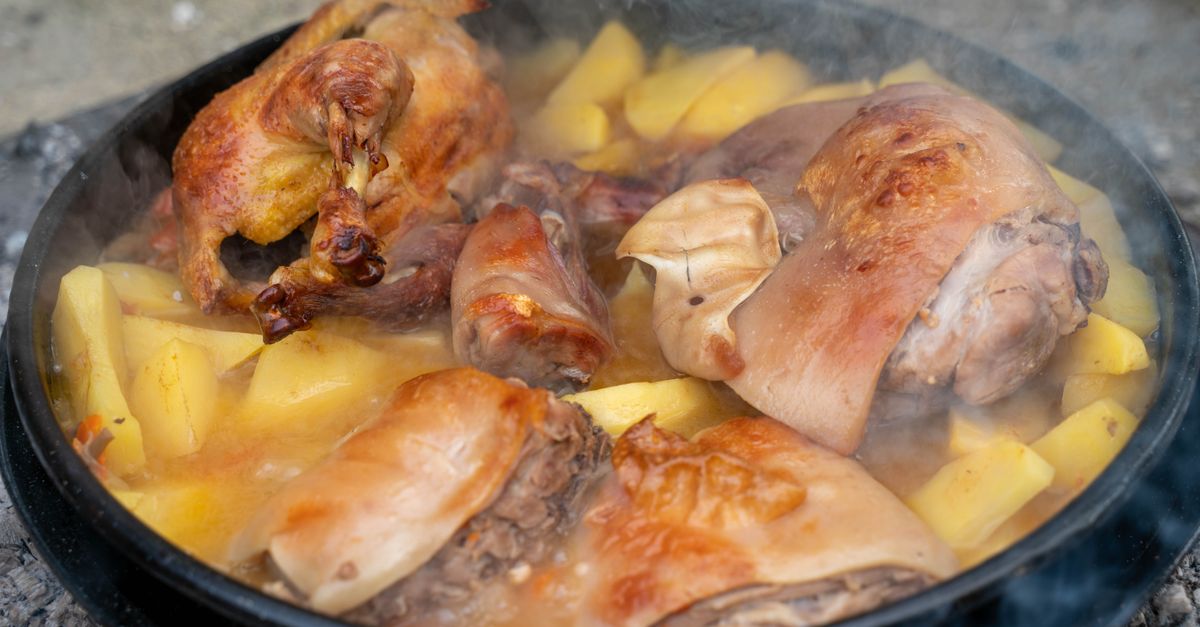
Medieval and early modern kitchens had few cooking vessels and limited access to tender cuts of meat. What they had were the tough, sinewy cuts that required long, slow cooking in liquid to become edible. One-pot methods like braising emerged not as haute cuisine but as practical solutions: you cook what you can afford in the equipment you have.
Over centuries, braising evolved from survival technique to intentional flavor-building. The long cook times break down collagen into gelatin, creating richness. The liquid absorbs fat and fond from the meat. What started as “how do we eat this” became “how do we make this delicious.” The technique stayed the same. The reasons changed.
If you’ve ever braised short ribs or lamb shanks, you’re following a method invented by people who couldn’t afford anything better. It just happens to produce some of the best textures and flavors you can coax out of meat.
6. Blanching: Restaurant Vanity That Went Mainstream
Blanching vegetables—briefly boiling them, then shocking them in ice water—is about two hundred years old. It was formalized in 19th-century French haute cuisine for one reason: to keep vegetables bright green on the plate.
Blanching stops enzymatic activity that would otherwise dull color and texture. It’s a visual technique. Restaurants needed it because presentation mattered; diners were paying for food that looked perfect, not just tasted good. Home cooks before that era didn’t blanch. They didn’t need to.
The technique trickled down from professional kitchens to home cooking, where it’s now taught as a fundamental. It works—blanched vegetables do hold their color and snap better—but it’s worth knowing you’re following a rule invented for plating aesthetics, not flavor necessity. Some traditions are just codified vanity.
7. Sous Vide: The Modern Anomaly
Sous vide is the outlier here. It wasn’t invented by accident or necessity. It was engineered.
In 1966, French physicist and chef Georges Pralus developed the technique to achieve precise temperature control in haute cuisine. The problem was specific: how do you cook a delicate protein to exact doneness across 50 servings? The answer was vacuum-sealing food in plastic and cooking it in a water bath at a controlled temperature.
Unlike searing or smoking, sous vide was born in the modern era with full understanding of the science. It’s a technique where theory came first, practice second. That makes it unusual in culinary history. Most cooking methods evolved the opposite way.
What You Inherit When You Cook
When you sear a steak, you’re repeating an experiment that medieval cooks ran for the wrong reasons but got right anyway. When you ferment cabbage, you’re enlisting the same lactobacillus bacteria that kept Northern European peasants alive through winter. When you braise short ribs, you’re using a technique invented by people who couldn’t afford tenderloin.
Most of what we call “technique” was just people solving problems with what they had. We inherited the solutions and, eventually, figured out the science. The interesting part isn’t that we still do these things. It’s that we do them for completely different reasons now—and they still work.