
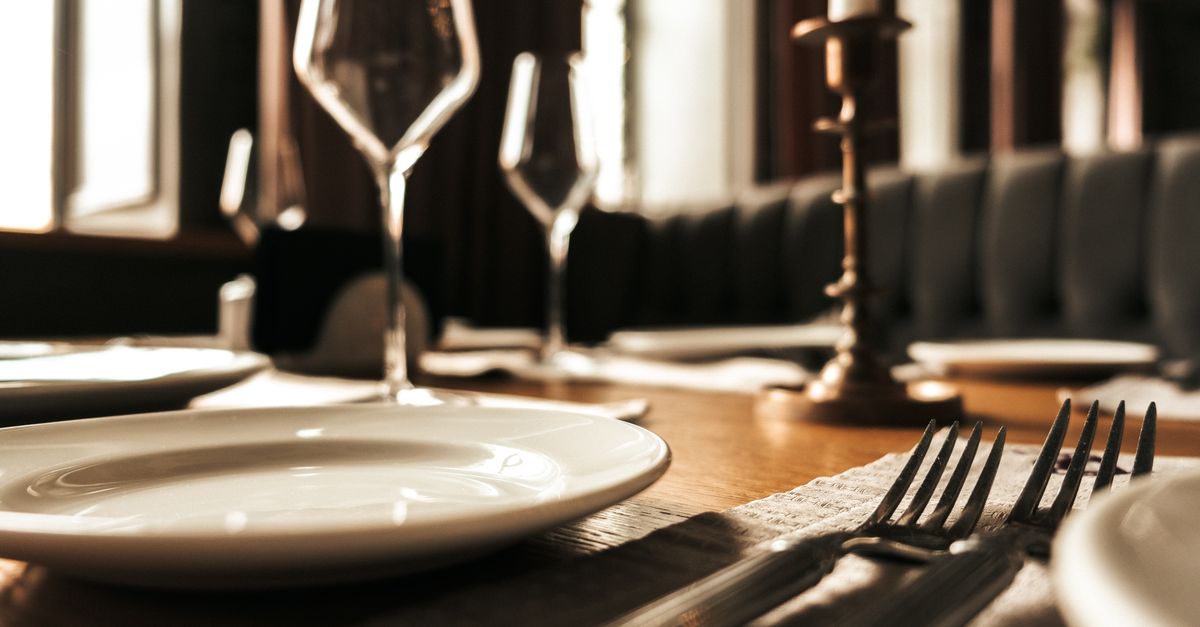
In 16th-century Europe, the fork was a scandal. Clergy called it unnecessary. Nobility called it effeminate. To use a fork was to reject God’s design—if we were meant to eat without touching our food, the thinking went, we wouldn’t have been given fingers. Venice and Rome adopted forks anyway, thanks to trade with the Byzantine Empire and Ottoman merchants who’d been using them for centuries. But in England and France, the fork remained suspect until well into the 1600s.
The short answer
Most dining rules you think of as ancient—the outside-in utensil order, the left-fork-right-knife placement, even the napkin-in-lap convention—were invented or codified by Victorians in the 19th century. They’re not timeless laws. They’re cultural technology that served a specific purpose: to signal education, wealth, and social standing. And they stuck because of a printing revolution that made etiquette manuals cheap enough to reach the middle class.
How the fork went from immoral to inevitable
The fork likely originated in the Byzantine Empire or Arabian Peninsula by the 4th or 5th century, according to food historians at the Smithsonian. It spread to medieval Italy by the 11th century, where it made sense—pasta is hard to eat with your hands. But it didn’t reach France until the 17th century, and England resisted even longer.
The turning point in England came in 1662, when Catherine of Braganza married King Charles II. Catherine brought Portuguese fork customs to the English court, and royal endorsement legitimized what had been mocked as an affectation just years earlier. If the queen used a fork, you could too—without looking weak.
Before that, the fork had a morality problem. In her book The Rituals of Dinner, historian Margaret Visser documents how European critics viewed forks as:
- Unnecessary, since fingers worked fine
- Effeminate, a tool for the delicate and weak
- Sacrilegious, because avoiding hand-to-mouth contact rejected the way God designed us
This wasn’t fringe opinion. It was mainstream resistance to a technology that felt foreign and fussy. We forget that every common object was once new and strange.
Why your forks are lined up that way—and why the rule stuck

The “outside-in” rule—use the utensil farthest from your plate first, working inward with each course—is a Victorian invention. It appears in 19th-century etiquette manuals, not medieval texts. The reason it exists is practical, not mystical.
At a formal Victorian banquet, you might face six or eight utensils. Which fork do you use for the fish course? The outside-in rule answers that question silently. Each course brings a new utensil, so “outside” always means “what’s next.” You never have to ask. You never reveal that you don’t know.
This is the point. Dining rules weren’t about morality—they were about sorting people. If you knew which fork to use, you’d been educated (or at least coached). If you didn’t, you weren’t part of the club. The rules were a quiet test administered at every formal meal.
But here’s what most histories miss: the reason these Victorian rules became “the” rules—rather than just another set of regional customs—is that they were the first to be mass-printed. Before the 1800s, etiquette guides were rare, handwritten, expensive manuscripts owned by aristocrats. Regional variations flourished because there was no single authoritative text.
That changed when printing technology made books cheap. Emily Post’s Etiquette (1922), available through the Internet Archive, sold hundreds of thousands of copies. It standardized American table manners in a single generation. What had been fluid customs in different regions—how to hold a fork in Philadelphia versus Charleston, whether gloves stayed on through the soup course—became codified rules. Post’s outside-in utensil order wasn’t ancient wisdom; it was editorial decision-making, frozen into text and distributed at scale.
Printers needed consistent guidance to reprint manuals year after year. So regional variations got smoothed into a single “correct” system. The rules felt timeless because they were printed the same way in 1925, 1935, and 1945. We mistake widespread distribution for ancient origin.
The invisible machinery: how servants made rules automatic
The same logic explains why there were so many forks in the first place. Specialized utensils—oyster forks, fish forks, dessert forks—were a wealth signal. You could afford different tools for different courses. You had staff to polish them.
And here’s the mechanism most articles skip: wealthy diners never had to know the rules because their servants did. A properly trained household staff knew which fork went where, which course required which glass, and how to correct a place setting if a guest moved something. The rules became invisible infrastructure.
This is why dining etiquette felt effortless at the top of the social ladder—someone else was doing the work. A footman who set the table wrong would be reprimanded or dismissed. So the system self-corrected before the diner ever sat down. You didn’t need to memorize the outside-in rule if your staff had already placed the utensils in outside-in order and removed each one as its course finished.
Servant training manuals from the Victorian era, documented in historical collections at the Library of Congress, are more detailed on table-setting than the etiquette books written for diners. The servants were the enforcers. The diners were just performing a script someone else had written and staged.
This is also why the rules felt arbitrary to the middle class trying to adopt them in the early 1900s. They were learning a system designed to be handled by someone else. The middle-class dinner party host had to memorize what a footman would have known automatically—and then pretend it was natural.
The two styles that still confuse everyone
If you’ve ever watched someone eat and thought, “Wait, they’re holding their fork wrong,” you’ve encountered the Continental-versus-American divide. Neither is wrong. They’re just different timelines.
| Aspect | Continental Style | American Style |
|---|---|---|
| Fork position | Stays in left hand throughout meal | Switches to right hand for eating |
| The motion | Cut a bite, bring fork to mouth without switching hands | Cut bite, set utensils down, switch fork to right hand to eat |
| Origins | European tradition | Emerged in early 1900s, possibly from working-class efficiency practices |
The American style likely emerged in the early 1900s, possibly driven by working-class efficiency—faster meals, fewer pauses. Emily Post’s 1922 manual describes both styles as acceptable, which tells you this wasn’t a moral question even then. It was just regional variation that got frozen into place.
Americans think the Continental style is showy. Europeans think the American style is inefficient. Both are correct, which is another way of saying neither is.
What dining rules were really for

Here’s the part most etiquette guides skip: dining rules enforced hierarchy. They were a tool of social control, and in colonial contexts, they became a tool of cultural imperialism.
European powers often required colonized peoples to adopt “proper” meal manners as proof of “civilization.” If you ate with your hands—as millions of people in India, the Middle East, and Africa had done for centuries with sophisticated technique—you were deemed unrefined. If you learned to use a fork, you were fit for trade, diplomacy, or employment under colonial administration.
This was never about hygiene or practicality. Chinese and Japanese diners had developed sophisticated chopstick techniques centuries before Europe standardized the fork. Chopsticks require more precision than forks. The “forks equal civilized” narrative was never about the tool—it was about power.
The Victorians didn’t invent snobbery, but they systematized it. They turned informal customs into codified rules, wrote them into etiquette manuals, and exported them as universal standards. Like the tradition of white wedding dresses, our “traditional” dining rules are much newer than they feel—and far less neutral than they pretend to be.
Why we stopped caring—and when
For roughly three hundred years—1700 to 2000—strict meal manners were social currency in Europe and North America. Your grandparents would have been mortified by someone chewing with their mouth open at a dinner party. You scroll past it on TikTok without a second thought.
The collapse happened in stages. World War II disrupted formal dining customs across Europe and America—rationing made multi-course meals impossible, household staff took war jobs and never returned, and the temporary informality of wartime meals became permanent. By the 1950s, the eight-utensil place setting had contracted to three or four for most families. Gloves at dinner, mandatory in 1920, were optional by 1950 and gone by 1970.
The Emily Post Institute still maintains etiquette guidance, but the framing has shifted. Modern Post advice focuses on “consideration, respect, and honesty” rather than rigid fork placement. The current stance: etiquette is about making others comfortable, not performing status. That’s a 180-degree turn from the Victorian model, where the point was to make the uninitiated uncomfortable—to visibly exclude them.
This is historically unusual. We’re living through a generational shift where younger diners have decided that most etiquette rules aren’t worth inheriting. Casual dining has become the default. High-end restaurants now serve charcuterie boards and hand pies—foods explicitly meant to be eaten with your hands, rejecting the “forks equal refinement” assumption.
Part of this is practical. Fewer people host formal dinner parties. Fewer jobs require you to navigate a six-fork place setting. But part of it is philosophical. If the rules were invented to separate the educated from everyone else, opting out is a quiet form of refusal.
That doesn’t mean etiquette is dead. In formal contexts—job interviews over lunch, diplomatic dinners, weddings—the old rules still matter because everyone agrees they matter. But outside those spaces, we’ve decided that comfort and honesty beat performance.
FAQ
Where did fork etiquette come from?
The fork originated in the Byzantine Empire or Middle East around the 4th century but didn’t spread to Western Europe until the 11th–17th centuries. Early European adopters faced ridicule and moral criticism—forks were seen as unnecessary and even sacrilegious.
Why do formal place settings have so many forks?
Victorian-era banquets introduced specialized forks for different courses as a wealth signal. The outside-in rule (use the utensil farthest from your plate first) was codified in mass-printed etiquette manuals like Emily Post’s 1922 guide, which standardized what had been regional variations into a single “correct” system.
When did strict dining etiquette start to decline?
World War II marked the turning point. Rationing, the loss of household staff to war jobs, and wartime informality collapsed the eight-utensil formal dinner to three or four utensils by the 1950s. Mandatory accessories like dinner gloves disappeared between 1950 and 1970.
Are traditional table manners still important?
In formal or professional dining contexts—yes. In casual settings, most strict rules have become optional. Modern etiquette authorities like the Emily Post Institute now frame manners as “making others comfortable” rather than demonstrating status, a fundamental shift from the Victorian model.
How did table manners differ across cultures?
Chinese, Indian, and Middle Eastern cultures developed sophisticated eating techniques—chopsticks, injera, right-hand conventions—centuries before Europe standardized the fork. European dining rules were often imposed on colonized peoples as markers of “civilization,” a form of cultural imperialism that had nothing to do with actual hygiene or practicality.
The next time someone tells you there’s a “right” way to hold your fork, you can decide whether that’s a rule worth keeping or a Victorian anxiety you’d rather leave behind.